
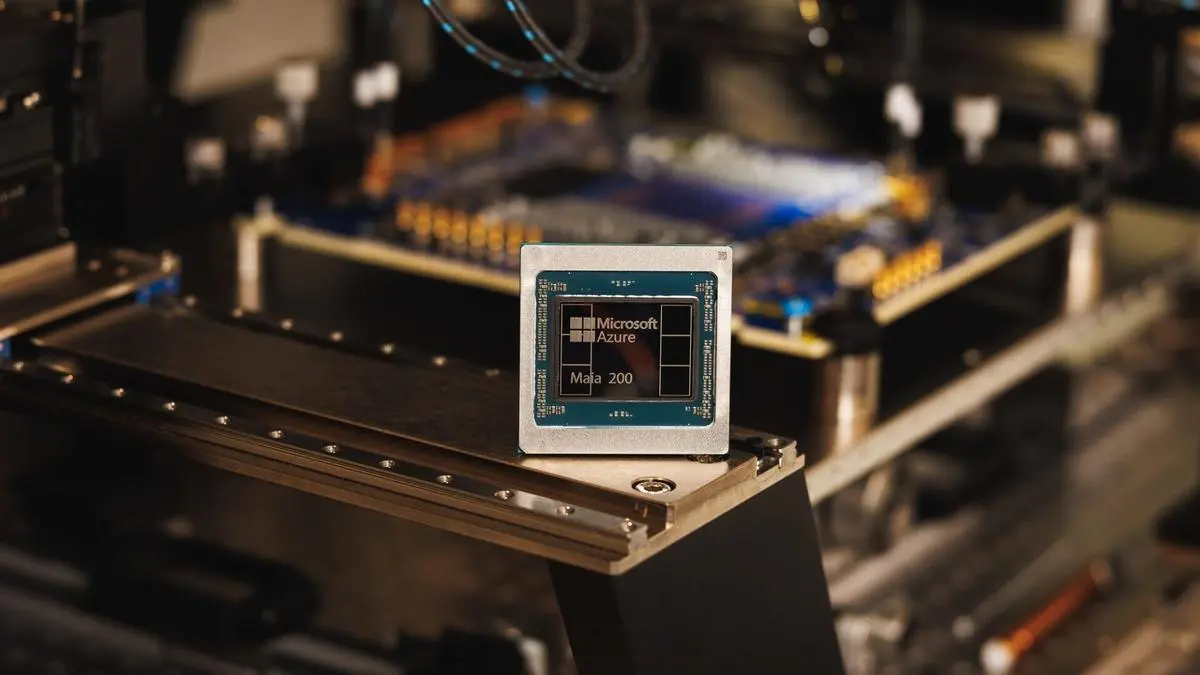

Microsoft has unveiled the second generation of its in-house artificial intelligence chip, Maia 200, along with new software tools designed to reduce its dependence on Nvidia.
Microsoft on Monday unveiled the second generation of its in-house artificial intelligence chip, along with software tools that target one of Nvidia’s biggest competitive advantages over developers.
Maia 200 start
The new “Maia 200” chip “goes online this week at a data center in Iowa, with plans for a second location in Arizona, Microsoft said.” It is the second generation of an AI chip called Maia, which Microsoft introduced in 2023.
The Maia 200 comes at a time when major cloud computing companies such as Microsoft, Alphabet’s Google and Amazon.com’s Amazon Web Services – some of Nvidia’s biggest customers – are producing their own chips that increasingly compete with Nvidia.
Google’s push
Google in particular has drawn interest from large Nvidia customers like Meta Platforms, which is working closely with Google to close one of the biggest software gaps between Google and Nvidia’s AI chip offerings.
Software stack
For its part, Microsoft said that along with the new Maia chip it would offer a “package of software tools for its programming.” This includes Triton, an open source software tool with key contributions from ChatGPT developer OpenAI that performs the same tasks as Cuda, the Nvidia software that many Wall Street analysts believe is Nvidia’s greatest competitive advantage.
Manufacturing technology
Like Nvidia’s upcoming Vera Rubin flagship chips unveiled earlier this month, Microsoft’s Maia 200 will be made by Taiwan Semiconductor Manufacturing Co using 3-nanometer chip manufacturing technology and will use high-bandwidth memory chips, albeit an older and slower generation than Nvidia’s upcoming chips.
Speed advantage
But Microsoft has also diverged from some of Nvidia’s emerging competitors by equipping the Maia 200 chip with a significant amount of so-called SRAM, a type of memory that can provide speed advantages to chatbots and other AI systems as they handle requests from large numbers of users.
Competitor playbook
Cerebras Systems, which recently signed a $10 billion deal with OpenAI to provide computing power, relies heavily on this technology, as does Groq, the startup from which Nvidia licensed the technology in a $20 billion deal.
Published on January 26, 2026