

The ocean adds something calm to your perspective. You can travel for years, climb cities and mountain ranges and take long-haul flights, and yet, I believe, there is nothing that gives you as much strength when you slip beneath the surface. Everything becomes softer. The noise subsides. Your thoughts don’t completely disappear, but they slow down enough to make room for wonder again.
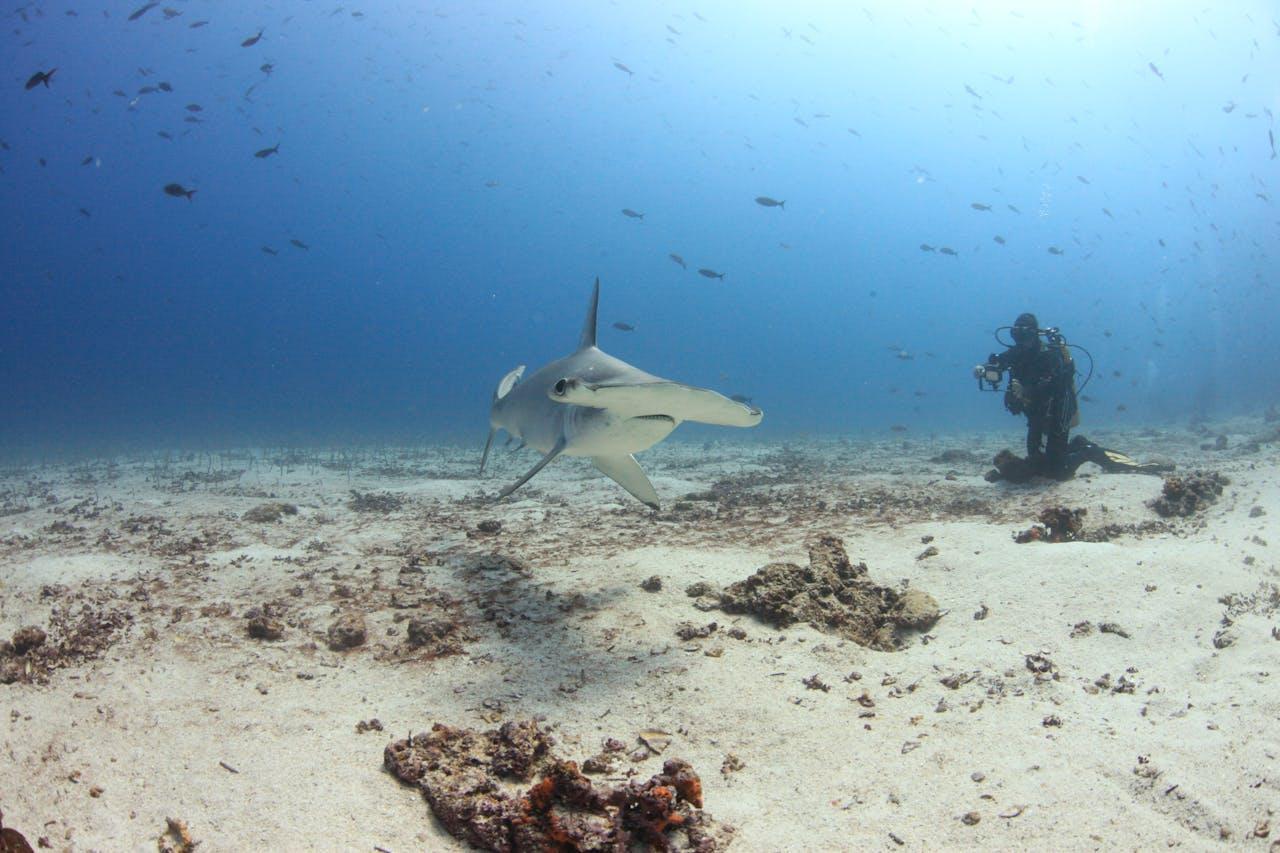
Some of the strongest travel memories people carry don’t come from sights at all. They come from moments that last just a few seconds – a shadow moving through blue water, the sudden swing of a fin, the strange calm of floating weightlessly over a living reef. For those drawn to diving and shark encounters, there are few experiences as surreal as encountering a school of hammerhead sharks in the open water. If that image has ever crossed your mind – even briefly – this guide to the best places to dive with hammerhead sharks is a calm, captivating place to start dreaming:
What follows is not about checking boxes or pursuing extremes for their own sake. These are encounters at sea that have a long lasting effect. The kind you think about months later, sometimes without knowing why. Ten moments scattered across the world’s waters that just might deserve their place on your travel list.
1. Swimming with hammerhead sharks in the open blue
Before you see her, a strange moment happens. The water feels empty. Almost too empty. And then slowly shapes begin to materialize – not hastily, not dramatically – just there. One line. Then another. Then suddenly a whole procession of hammerhead sharks moving with an ease that feels unreal.
Diving with these sharks isn’t about adrenaline like people often expect. It’s quieter. More attentive. You’re not chasing anything. You’re simply a guest, floating in your world, aware of your own smallness in a way that feels grounding rather than frightening. Places like the Cocos Islands and the Galapagos Islands have built quiet legends around these encounters, and rightly so. Few ocean moments seem so cinematic without trying.
2. Drifting with manta rays at a cleaning station
Manta rays move like thoughts that you almost remember. Slow. Broad. Effortless. Usually you’ll first spot them above you – a dark, slithering figure gliding through beams of light – and then they circle again and again, returning to the invisible boundary where reef fish silently do their work.
In places like Hanifaru Bay, the experience borders on meditation. They do not swim alongside the manta rays, but rather share their airspace. You get close enough to it that you can feel the displacement of the water against your mask. It’s gentle. Almost tender. And yet huge.
3. Watch the sardine hunt unfold in real time
While most encounters on the sea feel poetic, the sardine run feels mathematical. Millions of fish move at the same time. Bait balls contract, loosen, collapse, reform. Predators cut through each other at incredible speeds.
Off the coast of Port St. Johns, everything plays out like a living algorithm – dolphins herd, sharks strike, seabirds swoop from above. It’s chaotic, yes, but there’s a structure to it. Intelligence. Design. When you’re in the middle of it, you stop thinking in sentences. You think in motion.
4. Night diving with bioluminescent plankton
This is the kind of experience that is hard to photograph and even harder to explain. You enter black water. Real black. And then, with a wave of your hand, the light explodes around you in tiny sparks. Every step, every movement leaves a trail of glittering blue fire.
In sheltered bays around Vieques or Holbox, the sea becomes a drawing pad of light. It feels playful. Almost mysterious. It’s like the sea is letting you in on a trick that doesn’t work for everyone.
5. Dive the inside of the Great Blue Hole
It looks perfect from above. Even too perfect. A nearly circular darkness carved into turquoise waters off the coast of Belize City. It feels completely different from below.
You climb past sunlight, past familiar reef life, into cooler, darker water. Stalactites look like frozen teeth. Shadows expand. The dive isn’t particularly lively in a biological sense – and that’s the point. It’s about scale. Depth. The knowledge that you are floating in a structure that is older than memory as we understand it. It stays with you in a quiet way.
6. Snorkel with whale sharks on the surface
It always starts with disbelief. The key points. You strain your eyes against glare and waves. And then the largest fish in the world somehow appears next to your boat like a floating continent.
In places like Isla Mujeres and Donsol, whale sharks arrive seasonally, patient and unfazed by human excitement. Swimming next to one feels strangely humiliating. They match their pace for a few seconds, maybe a minute, before simply overtaking you without any effort. It turns out that size doesn’t imply power.
7. Exploring a living coral reef at dawn
During the day the reefs look busy. At dawn they feel purposeful. The first light slides over the coral edges. Fish appear in waves rather than en masse. Predators retreat. The people of Graz begin their quiet work.
In places like Raja Ampat, dawn dives reveal the reef not as a spectacle but as an awakening system. There is no soundtrack. Just silent movement and the strange feeling of having arrived before the world fully remembers itself.
8. Listen to the humpback whales beneath the surface of the water
You don’t always see them first. You often hear them. Quiet, resonant calls that seem to penetrate through bone rather than water. This is initially unsettling – a reminder that sounds behave differently down here.
In the waters off Moorea or Tonga, swimmers sometimes share space with migrating humpback whales. There is always distance. Respect. But even from a distance the presence is unmistakable. You feel like you’re being watched without feeling threatened. Observed by something older than the idea of tourism itself.
9. Drifting through a kelp forest in slow motion
Kelp forests do not report. They stand out. Long golden fronds rise from the darkness, moving with the tide like a slow, synchronized breath. Light falls downward in bands. Fish dart back and forth between the stems like punctuation marks.
Along the coast of Monterey Bay, diving through seaweed feels strangely earthly. It’s the closest thing to the ocean that feels like a forest you could walk through if gravity allowed. There is no need to rush here. The space encourages patience.
10. Free-floating over a deep-sea slope
There is no wall in front of you. No visible ground beneath you. Just the blue fading into a darker blue and then nothing that you can clearly define. Steep slopes like those in the Red Sea or on the edges of Indo-Pacific atolls lead to a subtle psychological change.
You become very aware of depth – not in meters, but in sensations. Your buoyancy. Your breathing. The invisible volume under your fins. It’s not necessarily fear. It is consciousness at full volume. And once you feel it, regular water never feels quite the same again.
A calm note on how we would like to experience the sea
It’s easy to chase these moments as trophies. A list. A map with pins. I did that sometimes too. But the longer you spend in and around the sea, the clearer it becomes that how you experience these encounters is just as important as how you see them in the first place.
Diving, when done wisely, is one of the few ways we are invited into this world without leaving it. Good buoyancy. Respectful distance. Guides who not only know where the animals are but also how to protect them. These details may seem small right now, but they shape the future of every encounter on this list. Maybe even whether they will still be possible in another generation.
At best, traveling changes something in us. When sailing, this happens quietly and without much fanfare. It demands attention. For patience. For restraint. And in return, it offers moments that don’t completely fade away – at least not completely – no matter how far you are from the water.
When you address these encounters, make time for them. Choose carefully. Move carefully. I think the ocean notices the difference.
About the author
Kyle is a travel writer and digital content specialist with a long-standing focus on wildlife travel, underwater exploration and responsible tourism. With years of experience working for global travel brands and independent publications, Kyle writes with a balance of curiosity and caution – drawn to the emotional pull of adventure, but always attentive to the ecosystems that make these experiences possible. More of this work, along with in-depth travel guides and reflective travel stories, can be found in the World Travel Guide. When Kyle isn’t exploring distant shores, he can usually be found refining story angles, exploring marine habitats, or quietly planning the next dive.