
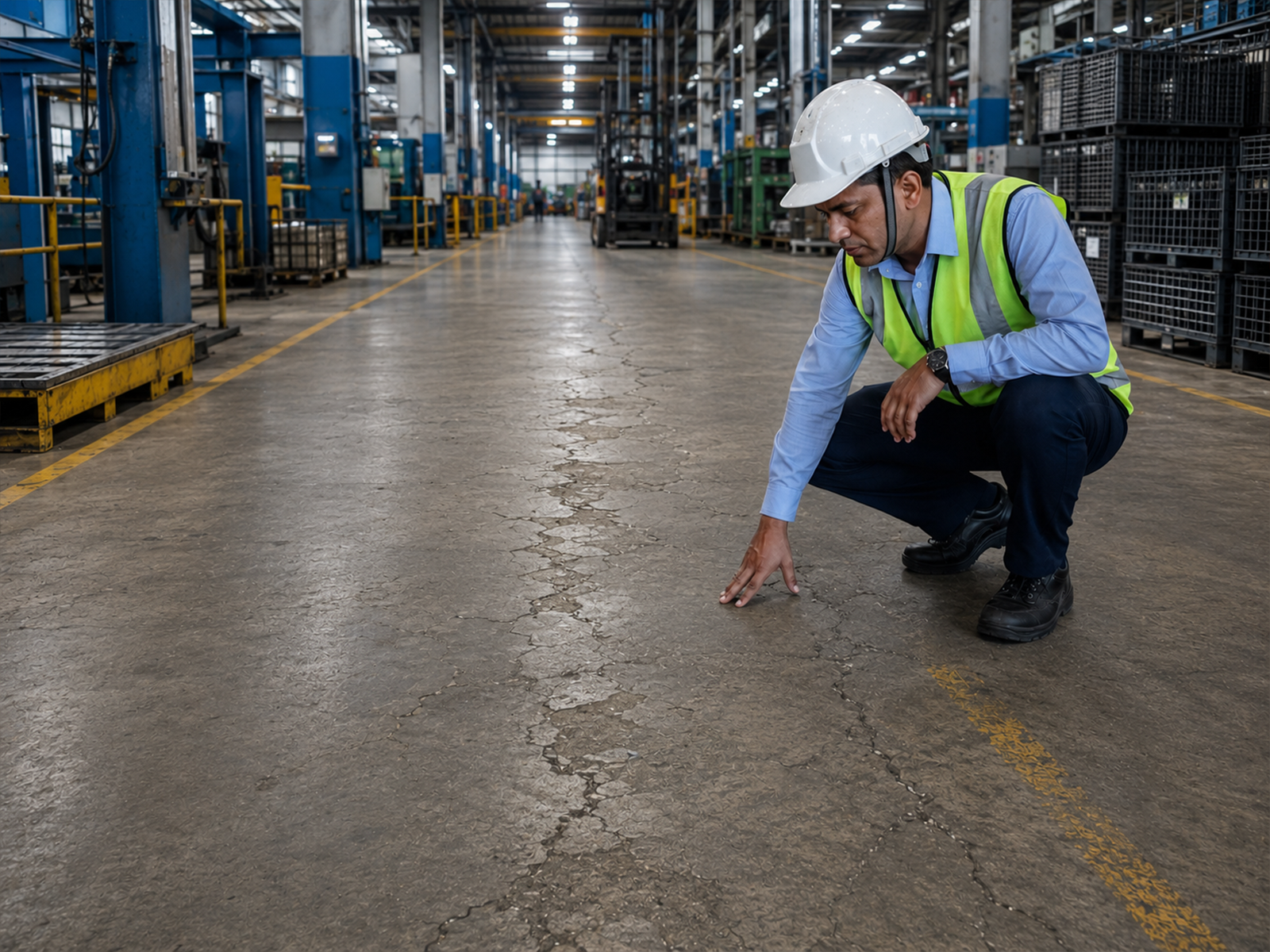

A maintenance manager at a components manufacturing plant decided, almost on a whim, to actually tally up a year’s worth of maintenance tickets by category before his annual budget review. He expected the usual suspects to dominate the list, conveyor issues, HVAC repairs, electrical faults. What he found instead was that floor-related complaints, dusting, cracked joints, uneven patches near the loading dock, accounted for more logged tickets than any other single category in the building.
He’d never have guessed it without the data. Floor problems don’t announce themselves the way a broken conveyor belt does. They accumulate quietly, one complaint at a time, until someone finally adds them up and realizes the floor has been the plant’s most persistent maintenance headache all along.
Why the Floor Wins This Contest So Often
Most equipment in a factory has a defined maintenance schedule, service intervals, wear parts, a clear owner responsible for keeping it running. Floors rarely get that same structured treatment. They’re poured once, largely ignored until something looks visibly wrong, and then addressed reactively, usually after the problem has already progressed further than it needed to.
That reactive pattern is exactly what drives floors to the top of a maintenance ticket count over time. A small joint crack that would have taken a few hours to reseal becomes a spalled, chipped edge that needs a more involved repair. A patch of surface dusting that could have been densified early on spreads across an entire aisle before anyone treats it as more than a housekeeping nuisance.
The Traffic Pattern Nobody Accounts For
Part of what makes factory floors uniquely prone to this is the sheer concentration of stress they absorb. Forklifts turning repeatedly at the same intersection, pallets dragged along the same aisle, machinery vibrating in one fixed spot for years, all of it applies a kind of continuous, repetitive load that most other building systems simply don’t experience in the same way. Understanding why industrial floors wear out at the specific points they do, rather than uniformly across the whole plant, is usually the first step toward actually managing the problem instead of just logging tickets about it.
This unevenness is also why floor maintenance tends to get underestimated. A quick walk through a factory rarely reveals how concentrated the wear actually is, since most of the floor looks perfectly fine. It’s the loading dock, the main aisle intersections, and the areas beneath fixed heavy equipment that carry a disproportionate share of the damage, and those specific zones are exactly where a smarter maintenance approach needs to focus.
Why Reactive Maintenance Costs More Than It Looks Like It Does
Every deferred floor repair compound. A joint that needs simple resealing becomes a joint that needs edge reconstruction. A dusting patch that needed densifying becomes a section that needs full grinding and resurfacing. None of this shows up as a single dramatic cost the way a major equipment failure does, which is exactly why it’s so easy for floor maintenance to stay underfunded even in facilities that are otherwise disciplined about upkeep.
Facilities that have actually tracked this properly tend to find that a proactive approach, catching joint wear and surface dusting early rather than waiting for it to become visually obvious, meaningfully reduces both the frequency and the size of floor-related maintenance tickets over time. Extending a floor’s working life through consistent, early attention turns out to be one of the higher-leverage maintenance decisions available in a typical factory, precisely because floors get so little structured attention by default.
What Changed After the Tally
The maintenance manager who ran that ticket count didn’t overhaul his entire budget overnight, but he did make one specific change: floor condition became a line item in the plant’s quarterly inspection routine, checked with the same regularity as the equipment maintenance schedule, rather than something addressed only when a complaint came in.
A year later, floor-related tickets had dropped noticeably, not because the floor had been replaced, but because problems were getting caught and treated while they were still small. The floor hadn’t become less important to the plant’s operations. It had simply stopped being the thing nobody scheduled time for, which turned out to be most of the problem all along.
About Floorzy
Floorzy is a concrete floor transformation company focused on improving the performance, durability, aesthetics, and longevity of existing concrete floors. The company develops customized floor transformation systems for factories, warehouses, schools, hospitals, parking structures, commercial buildings, and industrial facilities, and publishes ongoing research through the Floorzy Concrete Knowledge Library.